
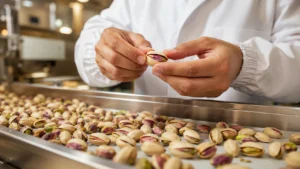
Where Is the Best Pistachio in the World?
Let me be clear: the best pistachio in the world comes from Iran. Not because of bias. Because of facts.
Iranian pistachio has a unique flavor. The kernel is more colorful and larger. The shell opens easily with your fingers. The earthy, nutty taste cannot be compared to any other pistachio in the world.
Americans produce large volumes, yes. But quality? No. California may have quantity, but Iran has quality.
Where Is the Best Iranian Pistachio Grown?
The best Iranian pistachio is grown in the mountain slopes of Kerman, Yazd, South Khorasan, and Semnan provinces. Cities like Rafsanjan, Zarand, and Anar are the heart of Iranian pistachio production.
Rafsanjan pistachio is a global brand. Anywhere in the world, if you say “Rafsanjan pistachio,” a professional buyer knows exactly what that means.
The Difficult Journey of Pistachio Production (Why Is It So Valuable?)
Pistachio production is one of the hardest agricultural jobs in the world. Let me show you the steps:
| Planting the seedling | A pistachio tree takes 7 to 10 years to reach full production. An Iranian farmer waits a decade before seeing a harvest. |
| Watering in the desert | Most pistachio orchards are in dry, low-water regions. Each tree needs 10 to 12 cubic meters of water per year. In a country with drought, that means sacrifice. |
| Manual pollination | Pistachio trees are male and female. Pollination must be done by humans. Farmers shake male branches to spread pollen to female trees. |
| Sensitive harvest time | Pistachio must be harvested at exactly the right time. A few days too early → sticky, unripe shell. A few days too late → cracked and dirty shell. |
| Drying and processing | Fresh pistachio must be dried quickly. If you delay, fungus grows and the whole batch is ruined. |
| Manual sorting | The best pistachios are sorted by hand. A machine cannot tell the difference between grade A and grade B. |
This is why Iranian pistachio is expensive. Behind every single kernel, there are years of patience, hard work, and knowledge of an Iranian farmer.
Health Benefits of Pistachio (Why You Should Eat It)
| Benefit | Description |
| Heart health | Pistachio lowers bad cholesterol and increases good cholesterol. |
| Blood sugar control | Unlike many snacks, pistachio does not raise blood sugar. |
| Plant protein source | Great for athletes and vegetarians. |
| Iron and copper | Good for anemia and bone health. |
| Vitamin B6 | Good for the nervous system and mood. |
| High antioxidants | Prevents cell aging and inflammation. |
The Place of Pistachio in Iranian Culture (Fascinating for Foreigners)
For Iranians, pistachio is not just a snack. It is a symbol.
| Occasion | Role of Pistachio |
| Gatherings and parties | No Persian table is complete without pistachio. It is a symbol of generosity and respect for guests. |
| Yalda Night | The longest night of the year. Families gather, eat watermelon and pomegranate, and crack pistachios. |
| Weddings | Pistachio, almond, and hazelnut in decorative bowls represent blessing and happiness. |
| Gifts | A box of high-quality pistachio is a very valuable and respectful gift. |
| Daily consumption | Many Iranians eat a handful of pistachio every day, like a natural supplement. |
There is a Persian saying: “You crack pistachio for a toothless mouth” — meaning pistachio is so valuable that giving it to someone who cannot enjoy it is a waste.
Pistachio in Persian Sweets and Dishes
Pistachio is not just eaten as a snack. It plays a key role in many Persian sweets and dishes:
| Dish/Sweet Name | Description |
| Baklava (Persian style) | Famous Persian sweet with thin layers of dough, rose water syrup, and crushed pistachio on top. |
| Sholeh Zard (Persian Rice Pudding) | Saffron rice pudding topped with cinnamon and chopped pistachio. |
| Nokhodchi (Chickpea Cookie) | Traditional cookie made with chickpea flour, cardamom, and crushed pistachio on top. |
| Tahchin ba Pesteh | Saffron rice cake with chicken or lamb, decorated with pistachio. A ceremonial dish. |
| Pistachio Halva | Halva made with butter, flour, rose water, and crushed pistachio. |
| Shir Berenj ba Pesteh | Traditional rice pudding topped with pistachio slivers. |
When a foreigner sees this list, they finally understand: pistachio is not just a nut. For Iranians, pistachio is the aroma and taste of their life.
Different Flavors of Iranian Pistachio
Like good wine, Iranian pistachio comes in different flavors:
| Type | Taste and Feature | Popularity in Iran |
| Raw pistachio | Mild, earthy taste, not very sweet | Has its own fans |
| Salted pistachio | Light salt brings out the nutty taste | Very popular |
| Saffron pistachio | Saffron turns the shell red, amazing aroma and taste | Most popular type in Iran |
| Roasted pistachio | Roasted over low heat, smoky and deep flavor | Popular in export markets |
| Lemon pistachio | Slightly sour and sweet | A matter of taste |
| Peppered pistachio | Spicy and sharp | Popular among younger people |
The Most Popular Pistachio Flavor in Iran: Saffron Pistachio
If a foreigner wants to understand what Iranian pistachio really means, they must try saffron pistachio.
Saffron pistachio is made by wetting the pistachio with salt water and saffron, then heating it. Saffron gives the shell a beautiful red color and brings an incredible aroma to the kernel.
The taste? First salt, then saffron, then the natural sweetness of pistachio. A three-stage journey in your mouth.
Most Iranians prefer saffron pistachio over any other type.
Why Do Different Countries Import Pistachio?
What do different countries use pistachio for? Let us see:
| Country | Main Use |
| United States & Canada | Raw snack, pistachio ice cream, Christmas cookies |
| Germany & United Kingdom | Baking and pastry (cakes, cookies with pistachio) |
| South Korea & Japan | Luxury gifts, pistachio cream, fancy sweets |
| UAE & Qatar | Pistachio chocolate (like Dubai chocolate), ceremonial desserts |
| Turkey | Baklava and traditional sweets |
| India & Pakistan | Pistachio meatballs (kofta), wedding sweets |
How Popular Is Pistachio in the World?
According to global statistics:
- The world consumes more than 1 million tons of pistachio every year.
- Iran produces about 30-40% of the world’s pistachio (depending on the year).
- Iranian pistachio is a well-known brand in European and Asian markets.
- Many professional buyers prefer Iranian pistachio over American pistachio (better taste and quality).
-
Even Hollywood movies and series have mentioned pistachio (for example, eating pistachio is a lovable habit in the series Friends).
Iranian Pistachio vs California Pistachio (The Real Competition)
Many buyers ask: which is better, Iranian pistachio or California?
Let me put the answer in one sentence: California has volume. Iran has quality.
Feature Iranian Pistachio California Pistachio Taste Deep, earthy, long-lasting on the tongue Mild, uniform Kernel color Purple-green (sign of ripeness) Cream to yellow Shell opening Opens easily with fingers Sometimes stiff and sticky Flavor variety Raw, salted, saffron, roasted, lemon, peppered Mostly salted and roasted Price Slightly higher (better quality) Slightly lower Production volume Lower (30-40% of world) Higher (50-60% of world)
Step by Step: How to Export Pistachio from Iran
Step 1: Request a Quote and Sample
- Buyer specifies pistachio type (Akbari, Ahmad Aghaei, Fandoghi, Kaleh Ghoochi) and flavor (raw, salted, saffron, roasted).
- Exporter gives price (FOB Bandar Abbas or CIF buyer’s port).
- A 1-2 kg sample is shipped.
Step 2: Contract and Deposit
- A Proforma Invoice is issued.
- Buyer pays a 30-50% deposit.
Step 3: Product Preparation
- Pistachio is sourced from the farm or warehouse.
- Pistachio is graded and packaged. Typical packaging: 10 kg, 25 kg, or 50 kg bags (vacuum or pallet).
Step 4: Export Certificates
- Phytosanitary Certificate (pest-free and disease-free)
- Lab Test Report (for pesticides and aflatoxin – this is very important for Europe)
- Certificate of Origin
- Organic Certificate (if available)
Step 5: Transport to Bandar Abbas
- Pistachio is trucked to Bandar Abbas port.
- Exit customs procedures.
Step 6: Loading and Document Submission
- Container is loaded. Unlike dates, pistachio usually does not need a refrigerated container. But humidity must be kept below a certain level.
- Bill of Lading and documents are sent to the buyer.
Step 7: Arrival at Destination Port and Customs Clearance
- Destination customs checks the documents.
- In Europe, aflatoxin testing is mandatory.
- Buyer pays the remaining balance (50-70%).
- Customs clearance and delivery.
Frequently Asked Questions (FAQ)
Q1: Which countries buy the most Iranian pistachio?
A: Germany, the United Kingdom, the UAE, South Korea, Japan, Russia, Kazakhstan, and Turkey.Q2: What is the difference between Akbari and Ahmad Aghaei pistachio?
A: Both are long, but Akbari is larger, more luxurious, and more expensive. Ahmad Aghaei has higher yield and a more reasonable price.Q3: Is Iranian pistachio allowed in Europe?
A: Yes, provided it has a valid lab test certificate and meets EU limits for aflatoxin and pesticides. Europe is strict, but it is possible.Q4: How can I tell if pistachio is fresh?
A: Fresh pistachio kernel is purple-green. If it is yellow or brown, it is old. The shell of fresh pistachio opens easily with your fingers.Q5: What guarantee is there that the pistachio is not moldy?
A: Aflatoxin testing. Every acceptable shipment must have a lab certificate showing aflatoxin below the legal limit.
Call to Action
We are a direct exporter of the best Iranian pistachio.
What we offer:
- Akbari (luxury, large, perfect for gifts)
- Ahmad Aghaei (long, economical, great for bulk orders)
- Fandoghi (round, ideal for industrial use and pistachio paste)
- Kaleh Ghoochi (large round, for special markets)
Certificates: Phytosanitary, aflatoxin lab test, Certificate of Origin
Sample shipment: Yes
The “Dubai Chocolate” Secret: Its Heart Comes from Iran
You have probably heard about the viral “Dubai Chocolate” craze. A chocolate bar filled with creamy green pistachio and crispy shredded pastry (kataifi) has taken the world by storm. It has over 120 million views on TikTok and has caused an international shortage of pistachios .
But here is the secret that many people do not know. The “soul” of this famous chocolate comes from Iran.
The Dubai chocolate trend has been so powerful that it has affected the global agricultural market. The main ingredient is pistachio kernels. Where do these come from? They are largely grown in either the US or Iran .
Because of this massive demand, Iranian producers exported 40% more pistachios to the UAE in just six months than they did in the entire previous year . Iranian pistachios are the preferred choice for this luxury product.